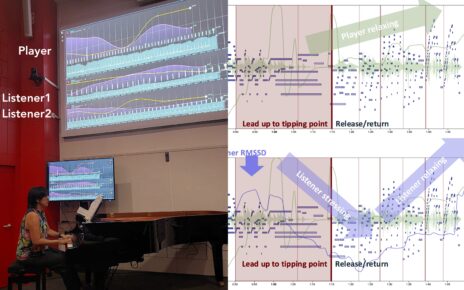

What happens when we listen to music? How do the phrase structures and big structural changes affect our heart rate, respiration, and blood pressure? How much do our personal perceptions of these structures matter for our physiologic reactions? Find out in
Natalia Cotic, Vanessa Pope, Pier D Lambiase, Elaine Chew, Autonomic entrainment to music structure in Verdi opera, European Heart Journal – Imaging Methods and Practice, Volume 4, Issue 1, January 2026, qyag025, https://doi.org/10.1093/ehjimp/qyag025
Lay Summary
Music has long been known to influence our bodies—our breathing, heart rate, and blood pressure. In this study, we set out to understand how the way a piece of music changes over time influences listeners’ physiological responses and how much personal perception and musical training affect the reaction. We focused on detailed measurements of cardiovascular and respiratory activity whilst volunteers listened to opera excerpts. Using advanced analytical methods, we examined how tightly physiological signals become linked to musical features like loudness, tempo, and structural changes in the music. These acoustic variations often take on arc-like formations, and we wanted to know whether people’s bodies synchronize to these shifts in real time. Our results show two key findings. First, specific musical features, especially sudden shifts in intensity or pacing, reliably evoke physiological reactions in listeners. Second, musical training and individual perception are superseded by the body’s subconscious reactions to musical structure changes. Together, these findings help explain why and how music affects people. They lay important groundwork for using music-based approaches in clinical settings -particularly in cardiovascular care, where regulating stress, breathing, and heart activity can directly impact patient outcomes.
Music Excerpts
Abstract
Aims: Music can influence bodily rhythms, offering a powerful way of modulating autonomic physiology. Entrainment between music structure and physiologic responses provides a potential mechanism for this effect. This study examined (1) whether autonomic entrainment is driven primarily by objective music structure or by listeners’ subjective perception of music boundaries and (2) how structural and dynamic features of opera shape entrainment.
Methods and results: Twenty-four participants (12 choristers, 12 non-choristers) listened to two Verdi excerpts while respiration, RR intervals, and continuous blood pressure were recorded. Entrainment between music features (loudness and tempo) and physiology was assessed using time-frequency coherence, revealing significant intra- and inter-individual coupling, strongest during Nabucco. Surrogate testing confirmed that these effects were linked to music structure rather than incidental physiologic fluctuations. Music boundaries were modelled as Gaussian envelopes derived from participant-defined (subjective) annotations and trained-annotator (objective) annotations. Objective boundary envelopes aligned more closely with physiologic envelopes than subjective annotations across signals. Subjective boundary performance improved when restricted to higher-strength annotations and when closely matching music structural changes. Choristers’ boundary annotations were more consistent within the group, but overall physiology–music entrainment strength was similar between choristers and non-choristers.
Conclusion: Music structure plays a key role in shaping autonomic entrainment. Autonomic entrainment during music listening is most consistently explained by music structure changes, particularly well-defined and salient boundaries (objective annotations), rather than by an individual’s perception of structure changes (subjective annotations). These findings support a scalable framework for music-based interventions grounded in extractable structural features rather than personalized perception.