
Learn what heart rate variability dynamics persist after music listening at Natalia Cotic’s presentation at the Wearables and Digital Twins in Cardiovascular Imaging e-poster session at 4:15PM-5PM on Friday, 28 August 2026, at the European Society of Cardiology Congress in Munich, Germany.

Wearables and digital twins in cardiovascular monitoring
28 August from 16:15 to 17:00
Station 4 (Research Gateway (Hall A1))
Moderated ePosters
Cardiovascular Signal Processing
Chairpersons
Gemma Figtree (University of Sydney – Sydney, Australia)
Alexios Antonopoulos (Hippokration General Hospital – Athens, Greece)

Heart rate variability dynamics reveal mechanisms for music-based autonomic modulation
Authors
N Cotic1 , V C Pope1 , P D Lambiase2 , E Chew1 , 1King’s College London – London – United Kingdom of Great Britain & Northern Ireland , 2Barts Health NHS Trust, Cardiology, Barts Heart Centre – London – United Kingdom of Great Britain & Northern Ireland ,
Abstract
Background: Music is increasingly recognised as a non-pharmacological modulator of cardiovascular autonomic function [1]. However, it remains unclear which musical features drive these effects, whether music alters mean autonomic tone or variability, and whether changes persist beyond listening.
Purpose: To quantify feature-specific autonomic responses to music and characterise acute and post-listening modulation of heart rate variability (HRV), a clinically relevant marker of vagal function and cardiovascular risk.
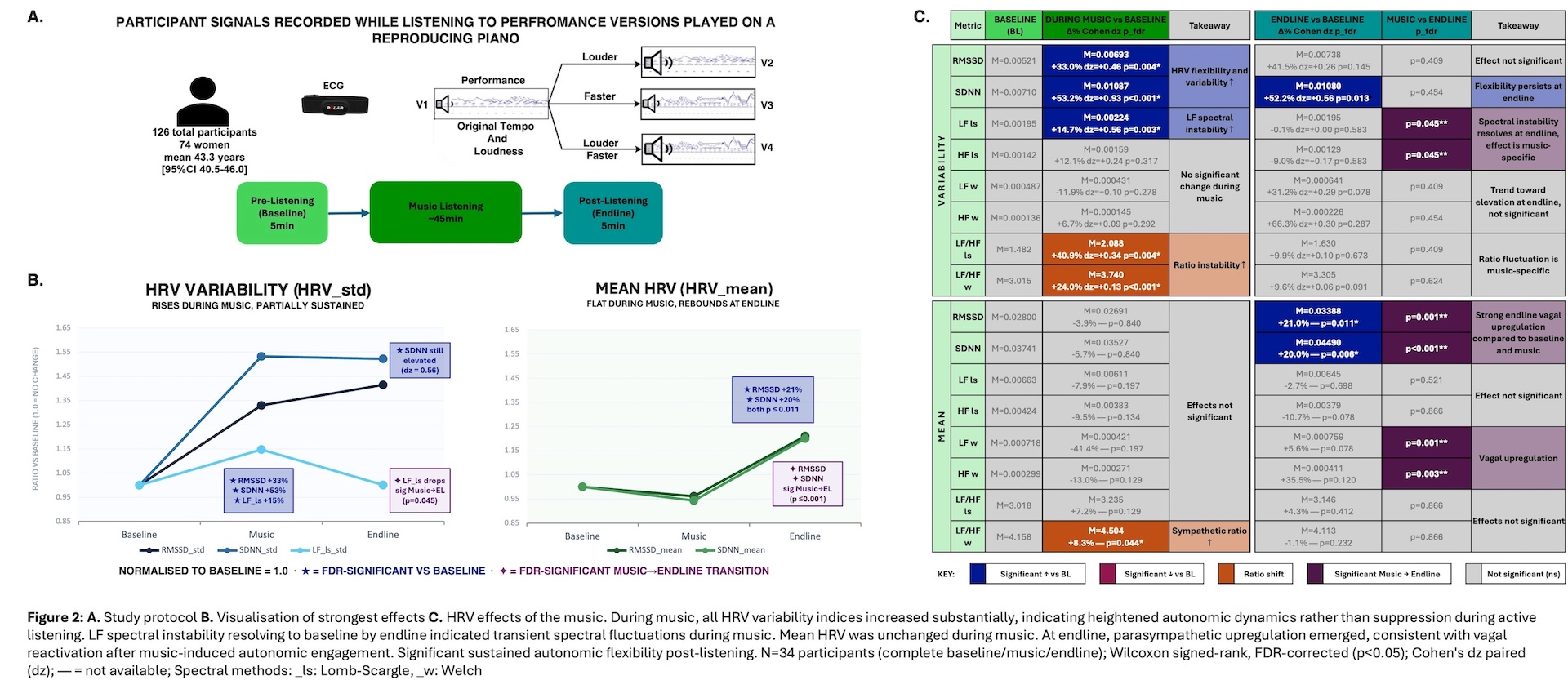
Methods: RR data were analysed from the HeartFM study [2], in which 126 participants (74 women; mean 43.3 years [95%CI 40.5–46.0]) listened to 9 piano tracks selected from a pool of 30 (Fig.2A). Of these, 34 had complete baseline and post-listening (endline) recordings. Time-domain (RMSSD, SDNN) and frequency-domain HRV metrics (LF and HF power, two spectral methods) were computed in 60s windows. Track-level analyses examined within-track HRV mean (HRV_mean) and standard deviation (HRV_std). Musical predictors included tempo and loudness, within-track acoustic spread, and phrase-arc structure (mean length and variability). Significance was assessed using ANOVA/Kruskal–Wallis, correlation analyses with FDR correction, and effect size with Cohen’s d.
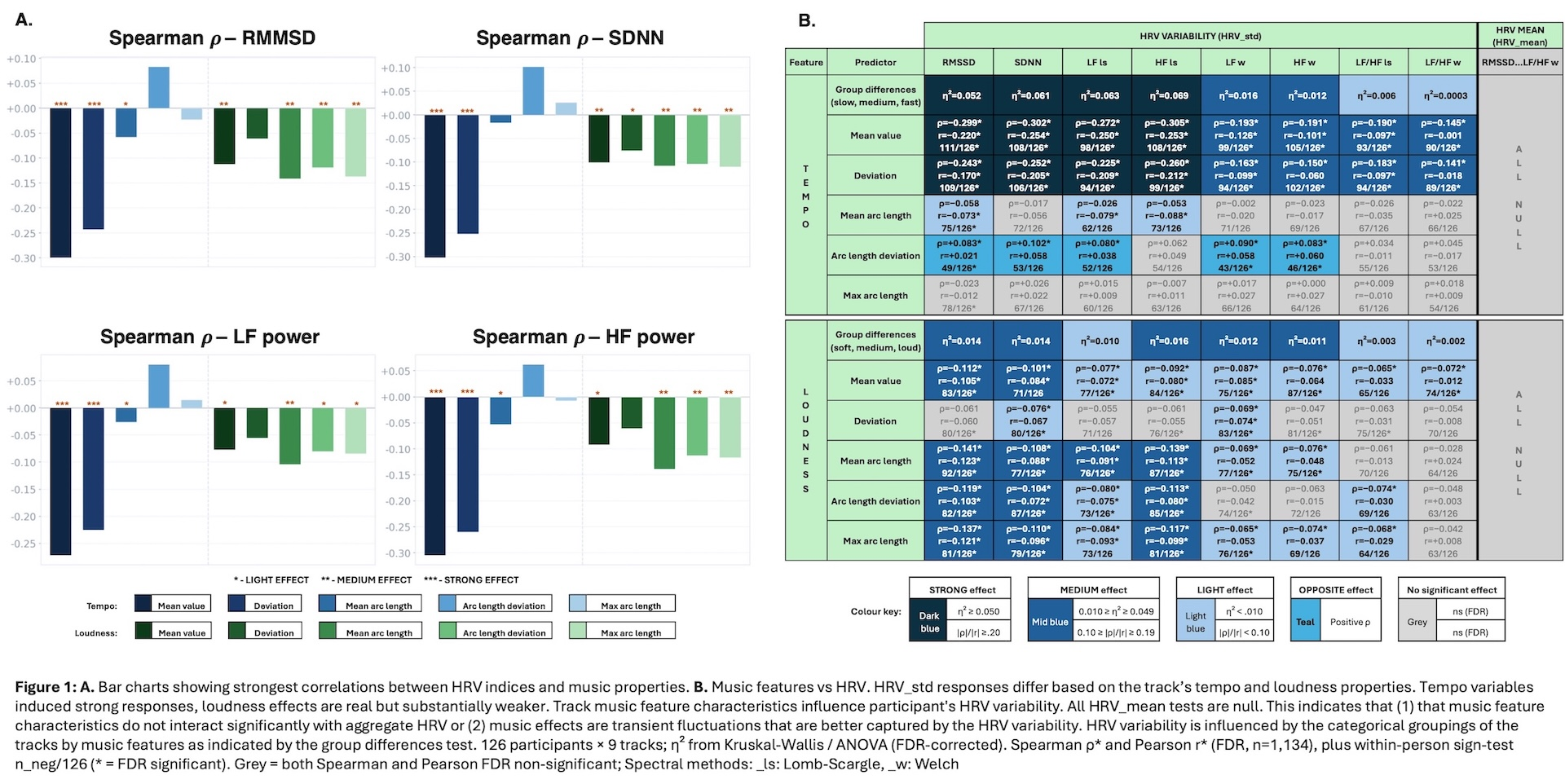
Results: No musical feature influenced HRV_mean at the track level. HRV_std, however, was strongly modulated by music. Tempo showed a stepwise suppression of HRV_std across all indices (η²=0.052–0.069; q<10⁻¹⁹), with faster tracks producing progressively lower within-track variability (RMSSD_std track-level r=−0.81; 111/126 participants negative, p<10⁻¹⁹). Within-track tempo std predicted lower HRV_std (ρ=−0.24; 109/126 negative), suggesting suppressive mechanism of wider tempo deviations. Loudness showed a weaker effect driven exclusively by the loudest tracks (η²≈0.01–0.02), with medium and soft levels statistically indistinguishable. Greater loudness phrase arc length and variability suppressed HRV_std. See Fig.1.
At session level, HRV_mean did not shift during music, but autonomic fluctuation increased (SDNN_std d=0.93; LF_std d=0.56; RMSSD_std d=0.46), reflecting dynamic engagement rather than a steady-state shift. Endline HRV_mean exceeded baseline (RMSSD +22%, SDNN +20%, both q<0.05) with no regression-to-mean effect, consistent with parasympathetic upregulation. Spectral HRV_mean power changes were not significant after FDR correction. HRV_std elevation persists at endline (SDNN_std p<0.021) while spectral variability normalised. See Fig.2.
Conclusions: Music modulates autonomic dynamics by altering variability during listening and enhancing vagal tone after exposure. These findings suggest music may “exercise” autonomic flexibility, potentially through entrainment [3], rather than simply induce relaxation. This has implications for the implementation of music-based interventions targeting autonomic flexibility in cardiovascular prevention and recovery.