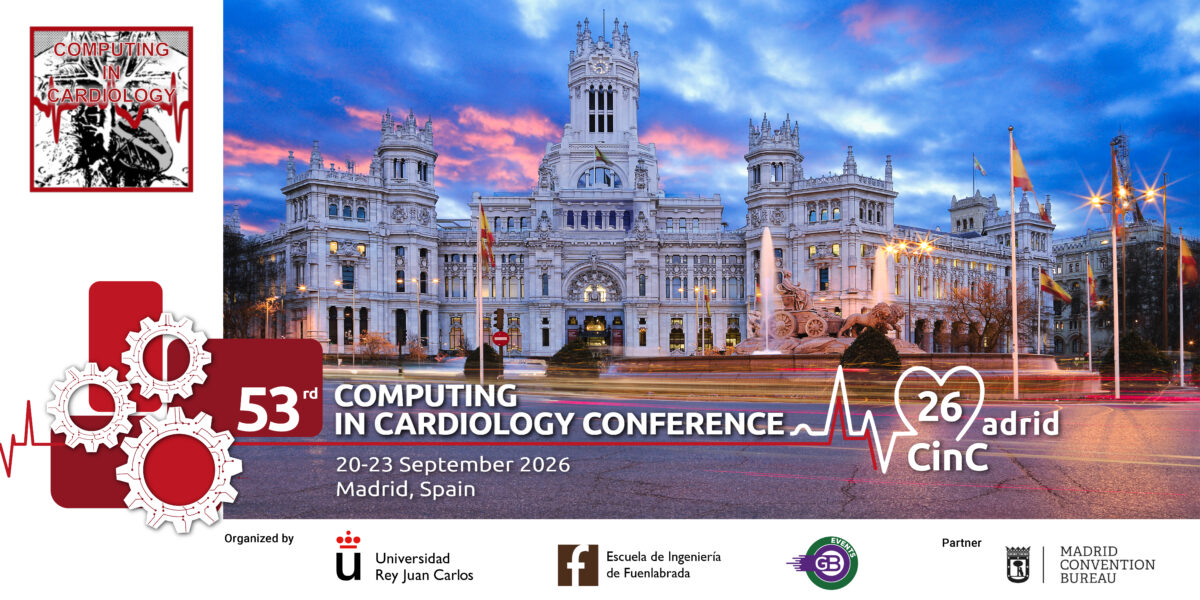
We are thrilled to have two contrasting papers led by doctoral candidates Wentao Hao on T-wave morphology of ensemble musicians in different action categories, and Ananth Venkatesh on stimulus specific autonomic responses to music accepted for poster presentations at this year’s Computing in Cardiology to take place in Madrid, Spain.
In addition, Ananth will be giving a talk on his previous work with Peter Langfield and Nasimba Nemaire at the IHU Liryc in Bordeaux on T-wave delineation.
All three presentations will take place on Tuesday, 22 September 2026. In chronological order:
Session S61 – 4a. Modern ECG models
3:45 PM – 5:15 PM
Convención 1
Chair: Valentina Corino
Co-Chair: José Luis Rojo
3:45 PM – 4:00 PM
Self-Supervised Learning for ECG Representation using Physiology-Informed Wavelet Transforms (45)
Ananth Venkatesh1, Masimba Nemaire2, Peter Langfield2
1Kings College London, 2IHU Liryc
Abstract: Deep learning for electrocardiogram (ECG) analysis typically requires large expert annotated datasets, which are costly and time-consuming to create. Self-supervised learning (SSL) provides an alternative by learning generalizable representations directly from unlabeled data. However, many existing SSL methods rely on augmentations inspired by computer vision or natural language processing that do not fully exploit the physiological characteristics of ECG signals. In this work, we introduce a wavelet-based SSL framework designed to incorporate physiological structure into ECG representation learning by using two time–frequency views of each signal, generated using continuous wavelet transforms with the magnitude of a standard Morlet wavelet and the phase of a custom wavelet derived from a unipolar electrogram model of ventricular repolarization. These representations are used within a Bootstrap Your Own Latent (BYOL) architecture with a TimeSformer encoder to learn invariant embeddings. The pretrained encoder is evaluated on the task of T-wave delineation using signals from the LUDB dataset. A regression head is finetuned to predict T-start, T-peak and T-end from the learned embeddings. The proposed method achieves state-of-the-art sensitivity compared with existing supervised approaches, reaching 99.96%, 99.96% and 99.92% for T-start, T-peak and T-end respectively, within the tolerance window suggested by AAMI. Moreover, strong performance is maintained when fine-tuning with only 20% of labeled data, highlighting the advantage of the learned representations. Furthermore, UMAP visualizations confirm that the embeddings organise signals by morphological cluster, suggesting that wavelet-based SSL can effectively capture ECG morphology and enable robust downstream analysis with limited annotations.
Session P2_7 – 7. Heart Rate and Cardiovascular Variability
5:15 PM – 6:45 PM
Quantifying Stimulus-Specific Autonomic Responses to Music Using Distributional Analysis and Contrastive Learning (93)
Ananth Venkatesh and Elaine Chew
Kings College London
Abstract: Music is known to modulate autonomic nervous system activity but determining whether these responses are consistent and stimulus-specific across individuals remains challenging due to inter-subject variability in response and temporal alignment. We investigated whether short-term heart rate variability and respiratory signals encode reproducible, stimulus-driven structure across listeners exposed to controlled musical stimuli. Physiological responses from 110 participants listening to 30 classical piano excerpts were represented as 56-dimensional vectors derived from seven autonomic markers (HR, RMSSD, LF, HF, LF/HF, respiratory rate, respiratory amplitude), summarized using distributional statistics and normalized per participant to remove baseline differences. Music stimuli were encoded as 72-dimensional representations derived from nine acoustic features, including tempo, loudness, and spectral and onset descriptors, similarly summarized over time. As autonomic responses can be slow, we first evaluated stimulus–response distributional coupling within participants using Earth Mover’s Distance (EMD). Responses were closer to their true stimulus than to random pairings (88.7% vs 50%, p < 0.001), indicating reliable stimulus specificity. We then trained a contrastive encoder (InfoNCE loss) to align physiological and acoustic representations across participants, achieving 0.906 accuracy on a match–mismatch task (chance 0.495 ± 0.021, p = 0.005). Stimulus features explained 14.1% of physiological variance (η² = 0.141), with within-stimulus similarity significantly exceeding across-stimulus similarity (cosine Δ = +0.141, p < 0.001). Participant discrimination remained at chance (0.50), confirming the model captures shared rather than individual-specific responses. Feature ablation identified respiratory amplitude, LF power, HF power and LF/HF ratio, as dominant contributors indicating autonomic engagement with stimuli. Some tracks characterised by higher tempo and onset density showed reduced HF and RMSSD and increased LF/HF ratios, suggesting parasympathetic withdrawal. These findings show that music induces weak but reproducible autonomic signatures driven by stimulus identity rather than individual physiology, supporting the use of controlled auditory stimuli for probing autonomic function.
Session P2_4b – 4b. ECG Analysis
5:15 PM – 6:45 PM
T-Wave Time-Warping Morphology Analysis During Music Performance (555)
Wentao Hao1, Michele Orini1, Julia Ramírez2, Elaine Chew1
1King’s College London, 2University of Zaragoza
Conclusion: Significant T-wave morphology differences were observed across musical action categories during performance. Amplitude-domain changes persisted after controlling for heart rate, while overall temporal changes were primarily heart-rate driven, suggesting that music performance modulates ventricular repolarisation dispersion beyond heart-rate adaptation. This work provides a framework for analysing ventricular repolarisation during active music engagement.
Aims: Music engagement modulates the autonomic nervous system. Its effect on heart rate variability (HRV) has been documented, but its impact on ventricular repolarisation remains unexplored. Here, we applied time-warping analysis to characterise T-wave morphology changes in musicians across different performance action categories during live ensemble playing and investigate whether the observed changes reflect intrinsic repolarisation modulation beyond heart rate adaptation.
Methods: ECG signals were collected whilst a professional ensemble (violin, cello, piano) performed Schubert’s Trio Op.100, Andante con moto, nine times during in-lab rehearsals, with pre-performance baseline and post-performance recovery. The musicians provided annotations of their performance action categories. For each session and category, mean warped T-waves were computed and four morphological markers extracted by comparing each category with the baseline template: temporal (dw) and amplitude (da) differences, and their nonlinear components dw_NL and da_NL. Repeated measures ANOVA with Greenhouse-Geisser correction and linear mixed-effects (LMM) models were applied. Repeated measures correlation assessed the association between T-wave markers and ∆RR.
Results: All four markers were significant in the pianist (p < 0.05), while only dw (p = 0.021) and da (p = 0.045) reached significance in the cellist, with musically intense categories such as Climax showing larger differences. The violinist’s data was not usable due to noise. After controlling for RR in LMM, da remained significant in both musicians (both p < 0.01) and da_NL (p < 0.001) in the pianist. In contrast, dw became non-significant in both musicians. Repeated measures correlation confirmed a strong dw–∆RR association.