What happens when we listen to music? Can we quantify how phrase structures and big structural changes affect our heart rate, respiration, and blood pressure? How much does predictability play a part in this response? Find out in
Natalia Cotic, Vanessa C Pope, Mateusz Soliński, Pier D Lambiase, Elaine Chew, Autonomic entrainment to expressive musical phrase structures, European Heart Journal – Imaging Methods and Practice, Volume 4, Issue 3, August 2026, qyag149, https://doi.org/10.1093/ehjimp/qyag149
Abstract
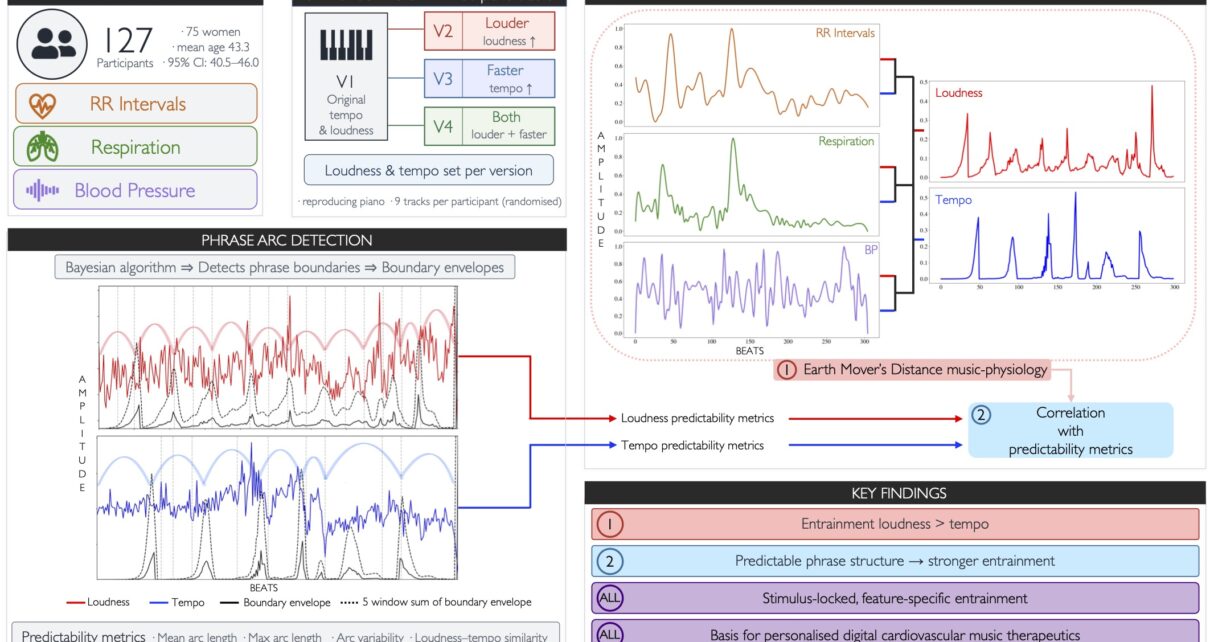
Aims: Music reliably influences autonomic physiology, yet the mechanisms linking expressive music structures to cardiorespiratory responses remain poorly understood. This study investigated how phrase-level organization in loudness and tempo relates to autonomic entrainment during music listening.
Methods and Results: We analysed multimodal physiologic recordings [electrocardiogram(ECG)-derived R-to-R intervals, respiration, continuous blood pressure (BP)] from 126 participants in the HeartFM study, each of whom listened to nine expressive solo-piano tracks drawn from a set of 30 (8 original + 22 feature-modulated versions) rendered on a reproducing piano. Music phrase structures were extracted using a Bayesian arc-detection algorithm, generating beat-level boundary profiles for loudness and tempo. Physiologic signals were converted into smooth envelopes and resampled onto the music-beat grid. Entrainment strength was quantified using Earth Mover’s Distance (EMD) between boundary profiles and physiologic envelopes, and evaluated against surrogate distributions. Participant-specific surrogate testing showed that original-vs.-surrogate separation was heterogeneous across physiological signals, with the strongest trend observed for tempo–BP waveform pairings. In contrast, loudness phrases showed consistently lower EMD than tempo phrases across most tracks. Phrase-arc summary statistics (mean and variability of arc length) and music-feature similarity provided measures of predictability. These metrics correlated with entrainment strength; more regular phrase structures were associated with greater synchronization.
Conclusion: Autonomic activity can be mapped to expressive phrase structures, with loudness showing stronger morphology-based alignment than tempo. Predictable phrasing and cross-feature congruence led to greater synchronisation. These findings characterize music–physiology coupling as a structure-dependent, quantifiable phenomenon, providing a mechanistic basis for feature-specific selection of music for eliciting autonomic responses.