

Mia Turakhia attends the American Heart Association (AHA) Scientific Sessions 2026 in Chicago, November 7-9, and presents a digital poster on the Effect of Pre-Procedure Recorded Music Exposure on Biomarkers of Anxiety and Stress: A Systematic Review and Meta-Analysis of Randomized Controlled Trials

Navigating Serious Illness: Palliative and Supportive Care in Cardiovascular Disease
Monday, Nov 09, 9:15am – 10:10am (Central)
Moderated Digital Poster 5‚ Clinical Science Zone 1
Effect of Pre-Procedure Recorded Music Exposure on Biomarkers of Anxiety and Stress: A Systematic Review and Meta-Analysis of Randomized Controlled Trials
Mia Turakhia, The Nueva Sch, Hillsborough, CA; Elaine Chew, King’s Coll London, London, United Kingdom
Background. Procedural anxiety, including for cardiovascular procedures, affects 40-80% of patients and is associated with physiological stress, autonomic dysregulation, and adverse outcomes. Passive listening of recorded (receptive) music may modulate stress and autonomic function in patients undergoing procedures.
Purpose. To quantify the effects of perioperative receptive music engagement in patients on autonomic and cardiovascular stress biomarkers, including heart rate variability (HRV), blood pressure, cortisol, and anxiety.
Methods. We conducted a systematic review and meta-analysis of randomized clinical trials (RCTs) comparing music with no-music control on stress biomarkers and self-reported anxiety. PubMed, Embase, CENTRAL, PsycINFO, and Web of Science were searched with pre-defined search strings for studies published between January 2008 and April 2026. Outcomes included HRV, cardiovascular biomarkers, cortisol, and anxiety using validated instruments. Music stimuli were assigned a Music Reporting Quality Score (MRQS, 0-3) based on eight Pedagogical Elements of Music criteria. We used Random-effects models with pooled Hedges’ g and Fisher’s exact test to assess stimulus-outcome associations.
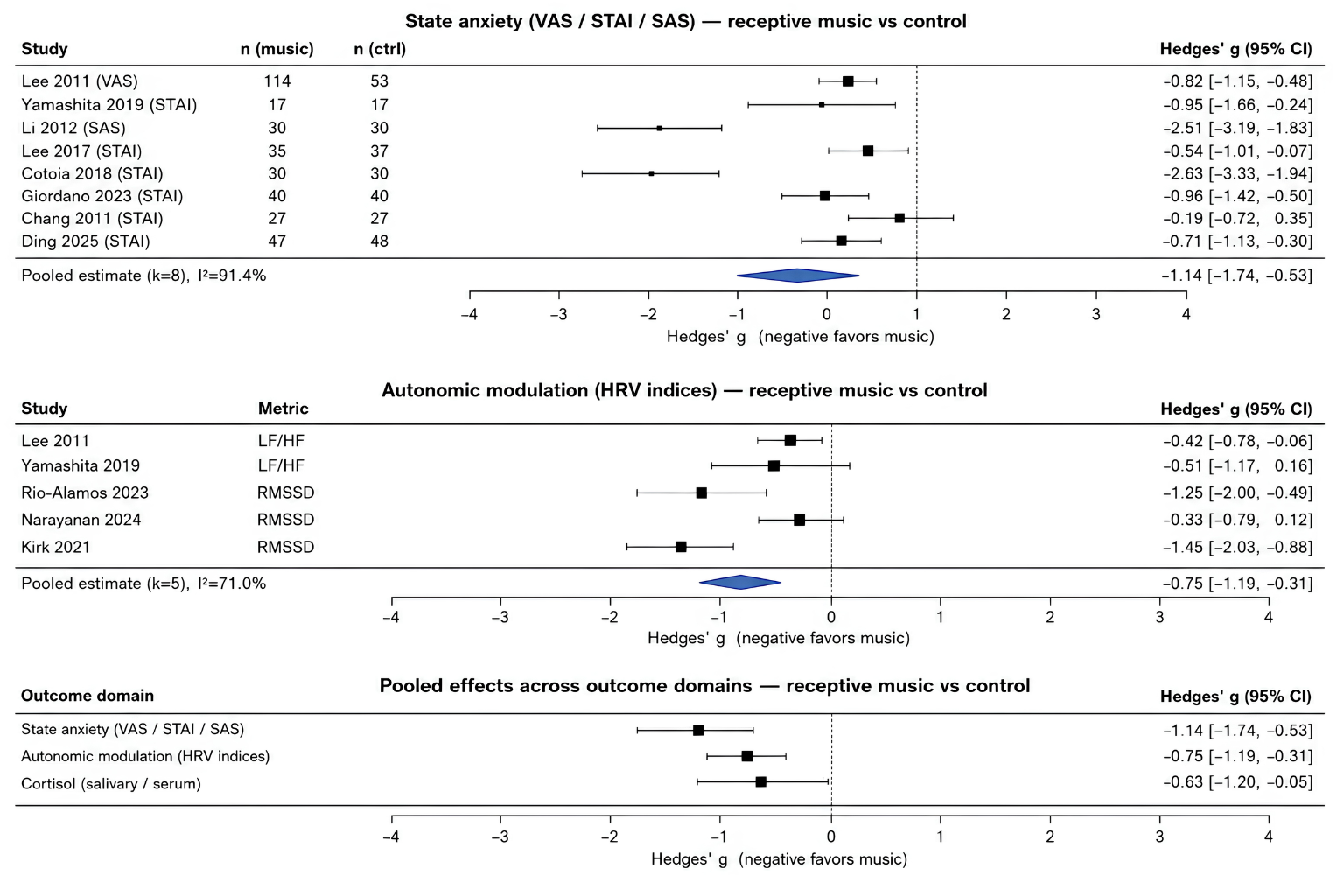
Results. Nineteen RCTs (N=1,463 participants; 12 countries; 2009-2026) met eligibility criteria; eight provided sufficient data for meta-analysis (N=497). 15/18 studies measuring anxiety and 13/17 measuring HRV showed improvements; cortisol was reduced in 3/3 studies. Across HRV trials reporting between-arm post-intervention means and SDs (k=5; RMSSD or sign-flipped LF/HF), pooled effect was g=−0.75 (95% CI −1.19 to −0.31; I²=71%), favoring music. Cortisol declined faster with music in two trials (g=−0.59; 95% CI −0.97, −0.21; k=2; I²=0%). Systolic BP fell 5-11 mmHg more with music in two cardiovascular trials. The pooled self-reported anxiety effect was Hedges’ g=−1.14 (95% CI: −1.74 to −0.53; p<0.001), indicating reduction of anxiety with music, although heterogeneity was considerable (I²=91.4%; τ²=0.69; prediction interval: −2.87 to +0.60). MRQS was the strongest predictor: none of the three MRQS=1 studies showed a significant effect, versus 81% of MRQS ≥2 studies (p=0.003). Studies of researcher-selected music outperformed self-selected music (91% vs. 25%; p=0.009). Slow tempo (≤80 BPM), where reported, was beneficial in 10/11 of studies. Intraoperative music under anesthesia was consistently ineffective; pre-operative and laboratory settings produced the largest effects.
Conclusions. Preoperative music exposure produces clinically meaningful reductions in anxiety and physiological stress and modulated by music tempo, music selection, and MRQS. Autonomic biomarkers were more consistent than self-reported anxiety ratings. These findings may inform future clinical outcomes trials.