

Today and tomorrow at the European Society of Cardiology’s Digital & AI Summit in Basel, Switzerland, 12-13 Nov 2026,
Wentao Hao will be presenting analyses of parasympathetic modulation in ensemble musicians (using musicians’ map of role dynamics) showing consistently reduced lnRMSSD associated with playing the main melody, engaging in musical dialogue, and creating a musical climax; and,
Ananth Venkatesh will be showing LLM analyses (work with Natalia Cotic) revealing fact that familiar music, music with which listeners have prior (extra-musical) associations, lead to reactions less aligned to music structures, which could explain why patient-selected music work less well in clinical studies
Posters and abstract reproduced below.
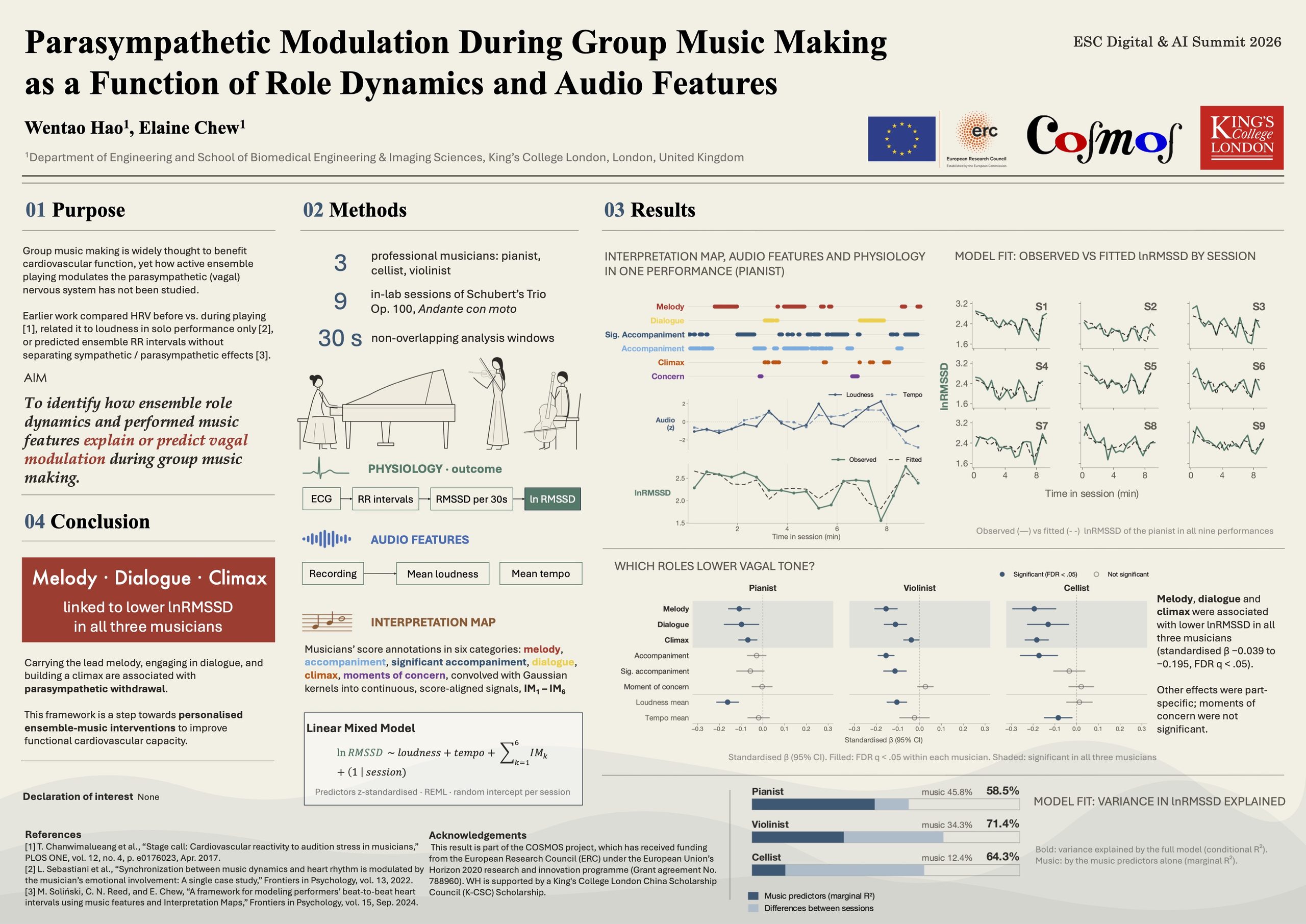
P137 – Parasympathetic modulation during group music making as a function of role dynamics and audio features
12th November 2026, 08:30 – 17:00
Authors: W Hao, E Chew
Background: Group music making is generally believed to be beneficial for cardiovascular function, but the mechanisms of how such music engagement modulates the parasympathetic nervous system has not been studied. The effect of active music engagement on the autonomic nervous system is reflected in the heart rate (HR) and heart rate variability (HRV). Previous studies have compared HRV before and during music making [1] and related it to loudness, only in solo performance [2]. More recent work predicted ensemble musicians’ RR intervals using an Intepretation Map (role dynamics) and music features [3] without separating sympathetic and parasympathetic effects. In this work, we focus on the vagal effects of active ensemble music making and model it as a function of an Interpretation Map and performed music features.
Purpose: To identify how ensemble role dynamics and performed music features explain or predict vagal modulation during group music making.
Methods: Three professional musicians (violinist, cellist, pianist) performed Schubert’s Trio Op. 100, Andante con moto nine times in a lab without audience whilst wearing chest-strap ECG sensors. The natural logarithm of their RMSSD (lnRMSSD) was computed in 30-second non-overlapping windows. The predictors of lnRMSSD were mean loudness and mean tempo (per window) and musicians’ Interpretation Map denoting categories such as melody, significant accompaniment, climax and moments of concern. The annotations were convolved with Gaussian kernels to produce continuous score-aligned signals. For each musician, a linear mixed model was fitted with predictive features as fixed effects and session-specific random intercepts.
Results: The model explained 58.5%, 71.4% and 64.3% of lnRMSSD variance (conditional R2) for pianist, violinist and cellist, respectively, of which music predictors alone accounted for 45.8%, 34.3% and 12.4% (marginal R2). All significant effects were negative, reflecting vagal withdrawal during music performance. For the pianist, loudness, melody, dialogue and climax were significant (β = −0.162 to −0.069); for the violinist, melody, accompaniment, significant accompaniment, dialogue, loudness and climax (β = −0.155 to −0.039); for the cellist, melody, climax, accompaniment, dialogue and tempo (β = −0.195 to −0.084). Melody, dialogue and climax were the most robust cross-instrument drivers of parasympathetic suppression, significant across all three musicians. Moments of concern were not significant.
Conclusions: Playing the lead melody, engaging in dialog, and collectively creating a musical climax are associated with parasympathetic withdrawal, with additional predictors specific to each musician/part. The proposed framework represents a step towards designing personalised ensemble music interventions to improve functional cardiovascular capacity.
References:
[1] T. Chanwimalueang et al., “Stage call: Cardiovascular reactivity to audition stress in musicians,” PLOS ONE, vol. 12, no. 4, p. e0176023, Apr. 2017, doi: 10.1371/journal.pone.0176023.
[2] L. Sebastiani, F. Mastorci, M. Magrini, P. Paradisi, and A. Pingitore, “Synchronization between music dynamics and heart rhythm is modulated by the musician’s emotional involvement: A single case study,” Frontiers in Psychology, vol. Volume 13 – 2022, 2022, doi: 10.3389/fpsyg.2022.908488.
[3] M. Soliński, C. N. Reed, and E. Chew, “A framework for modeling performers’ beat-to-beat heart intervals using music features and Interpretation Maps,” Frontiers in Psychology, vol. 15, Sep. 2024, doi: 10.3389/fpsyg.2024.1403599.

P219 – Identifying familiarity as an extramusical confound of music–autonomic coupling using LLMs
13th November 2026, 08:30 – 17:00
Authors: A Venkatesh, N Cotic, E Chew
Background: Music affects the autonomic nervous system, but studies on how it impacts physiology report heterogeneous results [1]. Music holds broad promise for digital cardiovascular therapeutics and diagnostics. However, reliable use of music requires understanding of extramusical factors that influence cardiovascular response, such as a listener’s familiarity with the music [2].
Purpose: Music structures entrain autonomic variables [3]. Here, we investigate whether familiarity alters entrainment to music structure through LLM-assisted analysis of participant’s description of familiarity with the music.
Methods: ECG, respiratory and blood pressure (BP) recordings were collected from 110 participants listening to 9 out of 30 classical piano renderings (Fig.1A) [4]. Participant comments were categorised into four familiarity classes [0: not familiar – 3: clearly familiar] using the Mistral 7B Instruct model (Fig.1B) [5]. 7 physiological features from heart rate variability (HRV) metrics, heart rate (HR), respiratory amplitude, and rate were compared with 9 music features to generate 63 music-physiology pairings (Fig.1C). Coupling was quantified using Earth Mover’s Distance (EMD) where lower EMD indicated closer pair alignment. EMD values were used to represent associations per track-participant pairing and were evaluated using statistical tests (Fig.1D). BP was also considered using mixed effect models.
Results: Multivariate analysis (MANOVA) demonstrated significant familiarity-associated shifts across the 63-dimensional coupling space (Wilks’ lambda, p<0.001). FDR-correction identified 29/63 significant music-physiology pairs; overall 52/63 demonstrated positive directionality. Loudness and HRV metric couplings were sensitive to familiarity levels (LF/HF: F=18.87, η²=0.062; HR: F=14.76, η²=0.049), indicating decreased alignment with increasing familiarity. Averaging EMD values across music features showed that participants more familiar with the tracks had weaker couplings (Fig.1E). Tempo had significant links with respiration (ρ=0.158, FDR p=2.65×10⁻⁶), RR intervals (ρ=0.171, FDR p=6.10×10⁻⁷), and BP (ρ=0.150, FDR p=6.48×10⁻⁶). Mixed-effects models showed weakest music–physiology alignment for tracks with the highest familiarity level compared with tracks that participants reported as unfamiliar.
Conclusions: Familiarity with music stimuli influenced music–physiology coupling, with greater familiarity associated with weaker autonomic and cardiovascular alignment. These findings suggest that extramusical factors such as familiarity may represent an important source of hidden inter-subject variability in music-based cardiovascular studies. More broadly, our work demonstrates the utility of LLM-assisted analysis of participant free-text comments for identifying external confounds, supporting the development of more reproducible and scalable music-based cardiovascular diagnostic and therapeutic applications.