Elaine Chew had a talk with Lisa Breit from “Der Standard” in the context of her upcoming lecture in the series Data Science @ Uni Vienna about some of her interdisciplinary approaches as pianist and mathematician.
DeepL translation with minor corrections. Original text (in German) at https://www.derstandard.at/story/2000097021129/uni-professorin-wer-mehr-als-eine-sache-macht-ist-kreativer

Interview
University professor: ‘People who do more than one thing are more creative’
Elaine Chew is a pianist and computer scientist in London. During her visit to the University of Vienna, she explained how the two fields are related.
Minutes: Lisa Breit
26 January 2019, 1:00 p.m.
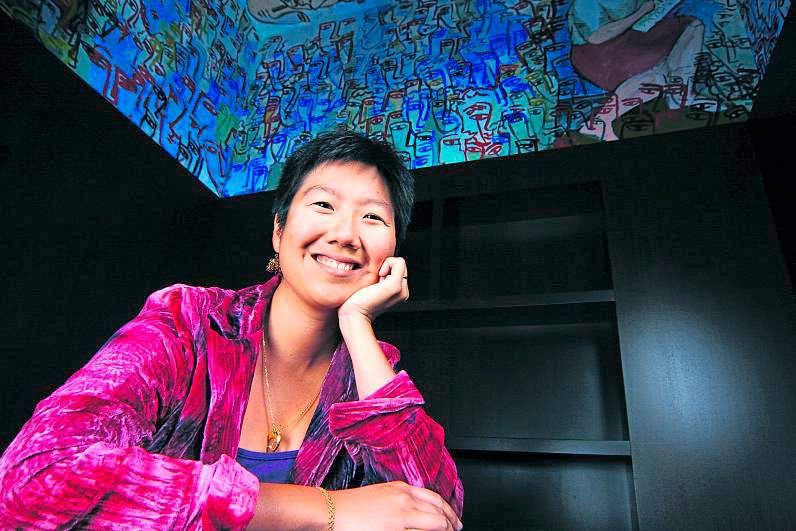
Setting priorities well allows her to pursue both careers, says Elaine Chew, pianist and professor of digital media.
Mathematics was virtually everywhere. When we moved, my father made cardboard models of the new house and our furniture and turned it into a so-called packing problem. We had to calculate the best way to arrange everything. When Rubik’s Cube came out, instead of just trying it out like everyone else, my father sat down and wrote equations for a possible approach. Even as a child, I was certain that I would become a mathematician one day.
My music career just happened, so to speak. Like many children, I learned an instrument, the piano. My parents thought that learning music was an important part of growing up, that it would be beneficial for my development into a well-rounded personality. To their surprise, I was really good at it. I was much better than they thought. However, this caused a bit of a dilemma: my teacher wanted me to go to the conservatory, but my parents wanted me to go to university. In the end, I enrolled at Stanford, where I was able to study a combination of subjects: mathematics, computer science, and music. It was a bold move to try both, but I have never regretted it.
I always tell my students: those who do more than one thing benefit enormously. You have many more opportunities to be creative, to make interesting connections, even between different subjects. It becomes easier to think outside the box. Ultimately, society as a whole benefits from this. Many important discoveries would never have been made if everyone had always concentrated on just one thing.
Analysing heart disorders
For my last interdisciplinary project, I worked with cardiologists. We attempted to diagnose cardiac arrhythmias using programmes that can analyse musical compositions. Usually, abnormal heartbeats are analysed based only on short, ten-second segments of signals. Changes over a longer period of time are ignored.
In music, we can recognise a song based on very short sections. I believe this could also help doctors to better understand different cardiac arrhythmias and how they develop over a longer period of time.
Pursuing an academic and a musical career at the same time is a real challenge. What helps me is consistent prioritisation. When I have a performance, I practise more and put other tasks on the back burner. When I was young, I wasn’t very diligent about practising. So I used a little trick: I learned to sight-read well.
What also helped me was that I always chose modern material. If I had played old music, such as Liszt études or Beethoven sonatas, I would certainly have had to practise much more. When you work with old pieces, the pressure is greater because so many good people have already recorded on them. It is much more work to develop a new interpretation of a standard piece than to play a new one.
The reason to keep going
I have developed some time management strategies. When I’m rehearsing for a performance, I play every day. I set aside a specific time slot for it. For example, I play from 7.30 a.m. to 9 a.m., then I go to university. I enjoy working with the students; I like passing something on to young people.
I can say that my life is very fulfilling. I have a family, a nine-year-old daughter. Spending time with her is very important to me; I want to know what’s going on in her head, what’s on her mind. I vaguely remember what it was like when I was nine, and that was a very important phase for me. My daughter also plays the piano and the cello.
The beauty of music is that it has an energising effect on me. Working on the computer doesn’t give me the same in return. When I finish a publication, it feels very satisfying and I’m proud, but making music is a more active pursuit, involving my hands and movements. Perhaps that’s why I keep going.
Elaine Chew (48) is a pianist and has been a professor of digital media at Queen Mary University in London since 2011. She previously taught at the University of Southern California. She studied at Stanford University and the Massachusetts Institute of Technology. Chew was born in Buffalo, New York.